後綴結構完全指南 — Suffix Array、Suffix Tree 與 LCP 陣列 | 資料結構與演算法
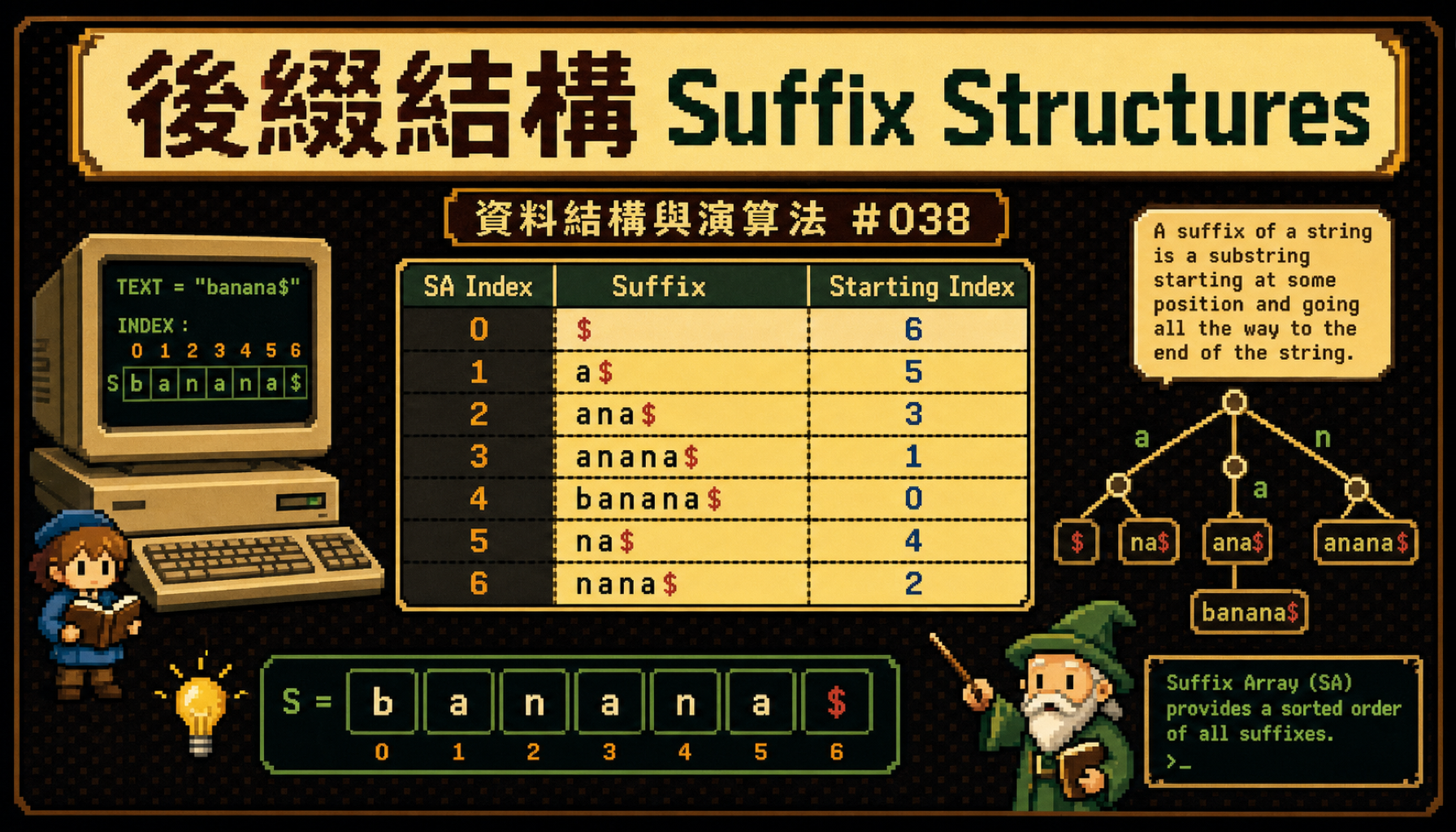
後綴結構(Suffix Structures) 是字串演算法中最強大的索引家族,涵蓋 Suffix Array(後綴陣列)、LCP Array(最長公共前綴陣列) 與 Suffix Tree(後綴樹) 三大核心。透過對字串所有後綴建立有序索引,我們能在 O(m log n) 時間內完成模式匹配、求解 最長重複子字串、計算 不同子字串數量,甚至支援全文搜尋引擎的底層索引。本文將從基礎概念出發,逐步掌握 倍增法、SA-IS 線性建構、Kasai’s Algorithm 等核心技術,搭配 JavaScript/TypeScript 與 C++ 雙語言完整實作。
前言
在前一篇文章中,我們探討了近似與線上演算法如何在 NP-hard 問題與即時決策場景下找到「足夠好」的解。本篇我們將進入字串演算法的深水區—— 後綴結構(Suffix Structures)。
字串處理是程式開發中無處不在的需求:從搜尋引擎的全文檢索、IDE 的自動補全、到生物資訊學中的 DNA 序列比對,都仰賴高效的字串索引技術。暴力的子字串搜尋需要 O(nm) 時間,而 KMP、Z-Algorithm 等單模式匹配演算法雖然將複雜度降至 O(n+m),卻無法高效處理「在同一文字上重複搜尋多個模式」的場景。
後綴結構 的核心思想是:對一個字串預先建立索引,之後每次查詢只需 O(m log n) 甚至 O(m) 的時間。這就像是為一本書建立「所有可能關鍵字」的索引——一旦索引建好,任何查詢都能快速完成。
學習本文後,你將能夠:
- 理解 Suffix Array、LCP Array、Suffix Tree 的定義與關聯
- 實作 倍增法 O(n log²n) 與 SA-IS O(n) 兩種 Suffix Array 建構法
- 使用 Kasai’s Algorithm 在 O(n) 時間建構 LCP 陣列
- 應用 Suffix Array 解決 模式匹配、最長重複子字串、最長公共子字串 等經典問題
- 認識 後綴自動機(SAM)、DC3 演算法 等進階變體
核心概念
後綴(Suffix)的基本概念
一個長度為 n 的字串 s,共有 n 個後綴。後綴 s[i..] 表示從位置 i 開始到字串結尾的子字串。
字串 s = "banana"(長度 n = 6,下標從 0 開始)

所有後綴:
  i=0: "banana"
  i=1: "anana"
  i=2: "nana"
  i=3: "ana"
  i=4: "na"
  i=5: "a"

觀察:任何子字串都是某個後綴的前綴
  例如 "nan" = 後綴 "nana" 的前 3 個字元
  → 這就是後綴結構能支援子字串查詢的根本原因
Suffix Array(後綴陣列)
Suffix Array(SA) 是將字串所有後綴按 字典序 排列後,記錄各後綴的 起始下標 所形成的整數陣列。
s = "banana"

按字典序排列所有後綴:
  SA[0] = 5  →  "a"
  SA[1] = 3  →  "ana"
  SA[2] = 1  →  "anana"
  SA[3] = 0  →  "banana"
  SA[4] = 4  →  "na"
  SA[5] = 2  →  "nana"

Suffix Array: SA = [5, 3, 1, 0, 4, 2]

Rank Array(SA 的反函數):rank[i] = 後綴 i 在 SA 中的位置
  rank[0]=3, rank[1]=2, rank[2]=5
  rank[3]=1, rank[4]=4, rank[5]=0
SA 的核心價值在於:後綴按字典序排列後,所有以相同子字串開頭的後綴會 聚集在一起,因此可以用 二分搜尋 在 O(m log n) 時間內找到任意模式。
LCP Array(最長公共前綴陣列)
LCP Array 記錄 Suffix Array 中 相鄰兩個後綴 的最長公共前綴(Longest Common Prefix)長度。lcp[i] 表示 SA[i] 和 SA[i-1] 對應後綴的 LCP 長度。
s = "banana",SA = [5, 3, 1, 0, 4, 2]

相鄰後綴比較:
  SA[0]=5: "a"
  SA[1]=3: "ana"     → LCP("a", "ana")     = 1  → lcp[1] = 1
  SA[2]=1: "anana"   → LCP("ana", "anana")  = 3  → lcp[2] = 3
  SA[3]=0: "banana"  → LCP("anana", "banana") = 0  → lcp[3] = 0
  SA[4]=4: "na"      → LCP("banana", "na")  = 0  → lcp[4] = 0
  SA[5]=2: "nana"    → LCP("na", "nana")    = 2  → lcp[5] = 2

LCP Array = [-, 1, 3, 0, 0, 2]
(lcp[0] 未定義,通常設為 0)
LCP 陣列的威力在於:
- 最長重複子字串 =
max(lcp[i]),對應位置為sa[argmax] - 不同子字串數量 =
n(n+1)/2 - sum(lcp[i]) - 搭配 Sparse Table(RMQ)預處理後,可在 O(1) 時間查詢任意兩個後綴的 LCP
Suffix Tree(後綴樹)概覽
Suffix Tree 是一棵壓縮的 Trie(Compressed Trie),將字串所有後綴插入後,合併僅有單一子節點的路徑。它在理論上非常優美:
Suffix Tree vs Suffix Array 對比:

特性            | Suffix Tree        | Suffix Array + LCP
───────────────|────────────────────|──────────────────────
建構時間         | O(n)(Ukkonen)     | O(n)(SA-IS)
空間             | ~20n bytes         | ~8n bytes(SA + LCP)
模式匹配         | O(m)               | O(m log n)
實作難度         | 極高               | 中等
快取效率         | 差(指標跳躍多)     | 好(連續陣列)
競賽/面試常用     | 少                 | 多

結論:Suffix Array + LCP 幾乎可以替代 Suffix Tree,
     且實作更簡潔、空間更少、快取更友善。
     本文以 Suffix Array + LCP 為主軸。
Ukkonen’s Algorithm 可在 O(n) 時間線上建構 Suffix Tree,但其實作極為複雜(需要處理 Active Point、Suffix Link、End Leaf 等機制),在面試和競賽中鮮少被要求手寫。因此本文將重點放在 Suffix Array + LCP 的實作與應用。
JavaScript / TypeScript 實作
Naive Suffix Array 建構
最直覺的做法是直接排序所有後綴。雖然時間複雜度較高(O(n² log n),因為字串比較本身需要 O(n)),但有助於理解 SA 的本質:
// ─── Naive Suffix Array 建構 O(n² log n) ──────────────────────

function buildSuffixArrayNaive(s: string): number[] {
  const n = s.length;
  // 建立 (後綴起始下標, 後綴字串) 的配對
  const suffixes = Array.from({ length: n }, (_, i) => i);

  // 直接按後綴字串的字典序排序
  suffixes.sort((a, b) => {
    // 逐字元比較後綴 s[a..] 和 s[b..]
    for (let k = 0; k < n - Math.min(a, b); k++) {
      if (a + k >= n) return -1; // 較短的後綴排前面
      if (b + k >= n) return 1;
      if (s[a + k] < s[b + k]) return -1;
      if (s[a + k] > s[b + k]) return 1;
    }
    return 0;
  });

  return suffixes;
}

// 測試
const s1 = "banana";
console.log("Naive SA:", buildSuffixArrayNaive(s1));
// 輸出:Naive SA: [5, 3, 1, 0, 4, 2]
倍增法建構 Suffix Array — O(n log²n)
倍增法(Prefix Doubling) 是競賽與面試中最實用的 SA 建構法,核心思想是:迭代地對「長度 2^k 的子字串」排序,每輪倍增子字串長度,利用上一輪的排名作為比較鍵。
// ─── 倍增法建構 Suffix Array O(n log²n) ──────────────────────

function buildSuffixArray(s: string): number[] {
  const n = s.length;
  // sa[i] = 字典序第 i 小的後綴的起始下標
  let sa = Array.from({ length: n }, (_, i) => i);
  // rank[i] = 後綴 i 的當前排名(初始為字元編碼)
  let rank = Array.from({ length: n }, (_, i) => s.charCodeAt(i));
  const tmp = new Array(n).fill(0);

  for (let gap = 1; gap < n; gap <<= 1) {
    // 比較函數:按 (rank[i], rank[i+gap]) 二元組排序
    const compare = (a: number, b: number): number => {
      if (rank[a] !== rank[b]) return rank[a] - rank[b];
      const ra = a + gap < n ? rank[a + gap] : -1;
      const rb = b + gap < n ? rank[b + gap] : -1;
      return ra - rb;
    };

    sa.sort(compare);

    // 根據新的排序更新 rank
    tmp[sa[0]] = 0;
    for (let i = 1; i < n; i++) {
      tmp[sa[i]] = tmp[sa[i - 1]];
      if (compare(sa[i - 1], sa[i]) !== 0) tmp[sa[i]]++;
    }
    rank = [...tmp];

    // 如果所有排名已唯一,提前結束
    if (rank[sa[n - 1]] === n - 1) break;
  }

  return sa;
}

// 測試
const s2 = "banana";
const sa2 = buildSuffixArray(s2);
console.log("SA:", sa2);
// 輸出:SA: [5, 3, 1, 0, 4, 2]
演算法解析:
- 初始化:將每個字元的 ASCII 碼作為初始排名
- 倍增迭代:每輪將 gap 翻倍(1, 2, 4, 8…),使用
(rank[i], rank[i+gap])作為排序鍵 - 更新排名:排序後根據相鄰元素是否相同來更新 rank
- 提前終止:當所有排名都唯一時,SA 已確定
共 O(log n) 輪,每輪使用比較排序 O(n log n),整體 O(n log²n)。若改用基數排序(Radix Sort),可優化至 O(n log n)。
SA-IS 線性建構 — O(n)
SA-IS(Suffix Array by Induced Sorting) 是目前最先進的線性 SA 建構演算法。其核心思想是將後綴分為 S 型(Smaller)和 L 型(Larger),找出 LMS(Left-Most S-type)後綴,遞迴求解子問題,再透過 Induced Sorting 推導完整 SA。
// ─── SA-IS 線性建構 Suffix Array O(n) ──────────────────────

function buildSuffixArraySAIS(s: string): number[] {
  // 將字串轉為整數陣列,加入哨兵字元 0(字典序最小)
  const arr = Array.from(s, (c) => c.charCodeAt(0) + 1);
  arr.push(0); // 哨兵

  const sa = sais(arr, Math.max(...arr) + 1);
  // 移除哨兵對應的位置(SA[0] 固定是哨兵)
  return sa.slice(1);
}

function sais(T: number[], alphabetSize: number): number[] {
  const n = T.length;
  if (n === 1) return [0];
  if (n === 2) return T[0] < T[1] ? [0, 1] : [1, 0];

  // Step 1: 分類每個後綴為 S 型或 L 型
  const isS = new Uint8Array(n); // 1 = S型, 0 = L型
  isS[n - 1] = 1; // 哨兵為 S 型
  for (let i = n - 2; i >= 0; i--) {
    if (T[i] < T[i + 1]) isS[i] = 1;
    else if (T[i] > T[i + 1]) isS[i] = 0;
    else isS[i] = isS[i + 1];
  }

  // 找出 LMS(Left-Most S-type)位置
  const isLMS = (i: number) => i > 0 && isS[i] && !isS[i - 1];
  const lmsPositions: number[] = [];
  for (let i = 0; i < n; i++) {
    if (isLMS(i)) lmsPositions.push(i);
  }

  // Step 2: 計算桶(Bucket)邊界
  const getBuckets = (end: boolean): number[] => {
    const count = new Array(alphabetSize).fill(0);
    for (const c of T) count[c]++;
    const buckets = new Array(alphabetSize).fill(0);
    let sum = 0;
    for (let i = 0; i < alphabetSize; i++) {
      sum += count[i];
      buckets[i] = end ? sum - 1 : sum - count[i];
    }
    return buckets;
  };

  // Induced Sort 核心函數
  const inducedSort = (lms: number[]): number[] => {
    const sa = new Array(n).fill(-1);

    // 放置 LMS 後綴到桶的末端
    let buckets = getBuckets(true);
    for (let i = lms.length - 1; i >= 0; i--) {
      sa[buckets[T[lms[i]]]--] = lms[i];
    }

    // 從左到右掃描,放置 L 型後綴
    buckets = getBuckets(false);
    for (let i = 0; i < n; i++) {
      if (sa[i] > 0 && !isS[sa[i] - 1]) {
        sa[buckets[T[sa[i] - 1]]++] = sa[i] - 1;
      }
    }

    // 從右到左掃描,放置 S 型後綴
    buckets = getBuckets(true);
    for (let i = n - 1; i >= 0; i--) {
      if (sa[i] > 0 && isS[sa[i] - 1]) {
        sa[buckets[T[sa[i] - 1]]--] = sa[i] - 1;
      }
    }

    return sa;
  };

  // Step 3: 第一次 Induced Sort(粗略排序 LMS)
  let sa = inducedSort(lmsPositions);

  // Step 4: 為 LMS 子字串命名
  const lmsNames = new Map<number, number>();
  let name = 0;
  let prev = -1;

  // 比較兩個 LMS 子字串是否相同
  const lmsEqual = (a: number, b: number): boolean => {
    for (let i = 0; ; i++) {
      const aEnd = i > 0 && isLMS(a + i);
      const bEnd = i > 0 && isLMS(b + i);
      if (aEnd && bEnd) return true;
      if (aEnd !== bEnd || T[a + i] !== T[b + i]) return false;
    }
  };

  for (const pos of sa) {
    if (!isLMS(pos)) continue;
    if (prev === -1 || !lmsEqual(prev, pos)) name++;
    lmsNames.set(pos, name);
    prev = pos;
  }

  // Step 5: 若名稱不唯一,遞迴求解子問題
  if (name < lmsPositions.length) {
    const reducedT = lmsPositions.map((p) => lmsNames.get(p)!);
    const reducedSA = sais(reducedT, name + 1);
    // 用遞迴結果的排序順序重新排列 LMS 位置
    const sortedLMS = reducedSA.map((i) => lmsPositions[i]);
    sa = inducedSort(sortedLMS);
  }

  return sa;
}

// 測試
const s3 = "banana";
console.log("SA-IS:", buildSuffixArraySAIS(s3));
// 輸出:SA-IS: [5, 3, 1, 0, 4, 2]

// 驗證與倍增法結果一致
const s4 = "mississippi";
console.log("SA-IS:", buildSuffixArraySAIS(s4));
// 輸出:SA-IS: [10, 7, 4, 1, 0, 9, 8, 6, 3, 5, 2]
SA-IS 的優勢在於 嚴格 O(n) 時間與空間複雜度,適用於超長字串(如基因組序列,長度可達數十億)。
Kasai’s Algorithm — O(n) 建構 LCP 陣列
Kasai’s Algorithm 利用一個關鍵觀察來實現線性時間的 LCP 建構。
核心引理(LCP Lemma):若後綴 s[i..] 與其在 SA 中前一個後綴的 LCP 長度為 h,則後綴 s[i+1..] 與其前一個後綴的 LCP 長度 >= h-1。
// ─── Kasai's Algorithm:O(n) 建構 LCP Array ──────────────────

function buildLCPArray(s: string, sa: number[]): number[] {
  const n = s.length;
  // 建立 rank 陣列(SA 的反函數)
  const rank = new Array(n).fill(0);
  for (let i = 0; i < n; i++) rank[sa[i]] = i;

  const lcp = new Array(n).fill(0);
  let h = 0; // 當前 LCP 長度

  for (let i = 0; i < n; i++) {
    if (rank[i] > 0) {
      const j = sa[rank[i] - 1]; // SA 中排在 s[i..] 前面的後綴
      // 逐字元比較擴展 LCP
      while (i + h < n && j + h < n && s[i + h] === s[j + h]) {
        h++;
      }
      lcp[rank[i]] = h;
      if (h > 0) h--; // 關鍵:h 最多遞減 1
    }
  }

  return lcp;
}

// 測試
const s5 = "banana";
const sa5 = buildSuffixArray(s5);
const lcp5 = buildLCPArray(s5, sa5);
console.log("字串:", s5);
console.log("SA:", sa5);   // [5, 3, 1, 0, 4, 2]
console.log("LCP:", lcp5); // [0, 1, 3, 0, 0, 2]
為何 O(n)? 變數 h 在整個迴圈中最多遞增 n 次(每次 while 迴圈成功匹配一個字元)、每次外迴圈最多遞減 1(共 n 次),因此 h 的總變化量為 O(n)。
模式匹配 — SA + 二分搜尋
利用 SA 的有序性質,可以用二分搜尋在 O(m log n) 時間內找到模式串 pattern 的所有出現位置。
// ─── SA + 二分搜尋模式匹配 O(m log n) ──────────────────────

function searchPattern(text: string, pattern: string, sa: number[]): number[] {
  const n = text.length;
  const m = pattern.length;

  // 比較後綴 text[sa[mid]..] 的前 m 個字元與 pattern
  const cmp = (mid: number): number => {
    for (let i = 0; i < m && sa[mid] + i < n; i++) {
      if (text[sa[mid] + i] < pattern[i]) return -1;
      if (text[sa[mid] + i] > pattern[i]) return 1;
    }
    return sa[mid] + m <= n ? 0 : -1;
  };

  // 二分搜尋左邊界(第一個匹配位置)
  let lo = 0, hi = n - 1, left = n;
  while (lo <= hi) {
    const mid = (lo + hi) >> 1;
    if (cmp(mid) >= 0) { left = mid; hi = mid - 1; }
    else lo = mid + 1;
  }

  // 二分搜尋右邊界(最後一個匹配位置)
  let right = -1;
  lo = 0; hi = n - 1;
  while (lo <= hi) {
    const mid = (lo + hi) >> 1;
    if (cmp(mid) <= 0) { right = mid; lo = mid + 1; }
    else hi = mid - 1;
  }

  if (left > right) return []; // 未找到
  return sa.slice(left, right + 1).sort((a, b) => a - b);
}

// 測試
const text1 = "mississippi";
const saText1 = buildSuffixArray(text1);
console.log('"issi" 出現位置:', searchPattern(text1, "issi", saText1));
// 輸出:"issi" 出現位置: [1, 4]
console.log('"ssi" 出現位置:', searchPattern(text1, "ssi", saText1));
// 輸出:"ssi" 出現位置: [2, 5]
console.log('"xyz" 出現位置:', searchPattern(text1, "xyz", saText1));
// 輸出:"xyz" 出現位置: []
最長重複子字串(Longest Repeated Substring)
LCP 陣列的最大值即為最長重複子字串的長度,這是 SA + LCP 最經典的應用。
// ─── 最長重複子字串 ──────────────────────

function longestRepeatedSubstring(s: string): string {
  const n = s.length;
  if (n === 0) return "";

  const sa = buildSuffixArray(s);
  const lcp = buildLCPArray(s, sa);

  let maxLen = 0;
  let maxIdx = 0;

  for (let i = 1; i < n; i++) {
    if (lcp[i] > maxLen) {
      maxLen = lcp[i];
      maxIdx = sa[i];
    }
  }

  return s.substring(maxIdx, maxIdx + maxLen);
}

// 測試
console.log(longestRepeatedSubstring("banana"));   // "ana"
console.log(longestRepeatedSubstring("abcabc"));   // "abc"
console.log(longestRepeatedSubstring("aaaaaa"));   // "aaaaa"
console.log(longestRepeatedSubstring("abcdef"));   // ""(無重複)
兩字串的最長公共子字串(Longest Common Substring)
將兩個字串用特殊分隔符拼接後建構 SA + LCP,再從 LCP 中找出分屬不同字串的相鄰後綴的最大 LCP 值。
// ─── 兩字串的最長公共子字串 ──────────────────────

function longestCommonSubstring(s1: string, s2: string): string {
  // 用不出現在兩字串中的字元作為分隔符
  const separator = "#";
  const combined = s1 + separator + s2;
  const n = combined.length;
  const boundary = s1.length; // 分隔符位置

  const sa = buildSuffixArray(combined);
  const lcp = buildLCPArray(combined, sa);

  let maxLen = 0;
  let maxIdx = 0;

  for (let i = 1; i < n; i++) {
    // 檢查相鄰後綴是否分屬不同字串
    const fromS1_curr = sa[i] < boundary;
    const fromS1_prev = sa[i - 1] < boundary;

    if (fromS1_curr !== fromS1_prev && lcp[i] > maxLen) {
      maxLen = lcp[i];
      maxIdx = sa[i];
    }
  }

  return combined.substring(maxIdx, maxIdx + maxLen);
}

// 測試
console.log(longestCommonSubstring("abcdef", "xbcdey"));  // "bcde"
console.log(longestCommonSubstring("ABABC", "BABCBA"));   // "BABC"
console.log(longestCommonSubstring("hello", "world"));    // "l"
C++ 對照
以下提供 C++ 版本的 Suffix Array + LCP 核心實作,方便需要在競賽或系統層面使用的讀者:
#include <bits/stdc++.h>
using namespace std;

// ─── O(n log²n) 倍增法建構 Suffix Array ──────────────────────

vector<int> buildSuffixArray(const string& s) {
    int n = s.size();
    vector<int> sa(n), rank_(n), tmp(n);

    iota(sa.begin(), sa.end(), 0);
    for (int i = 0; i < n; i++) rank_[i] = s[i];

    for (int gap = 1; gap < n; gap <<= 1) {
        auto cmp = [&](int a, int b) {
            if (rank_[a] != rank_[b]) return rank_[a] < rank_[b];
            int ra = (a + gap < n) ? rank_[a + gap] : -1;
            int rb = (b + gap < n) ? rank_[b + gap] : -1;
            return ra < rb;
        };
        sort(sa.begin(), sa.end(), cmp);

        tmp[sa[0]] = 0;
        for (int i = 1; i < n; i++) {
            tmp[sa[i]] = tmp[sa[i-1]] + (cmp(sa[i-1], sa[i]) ? 1 : 0);
        }
        rank_ = tmp;
        if (rank_[sa[n-1]] == n-1) break;
    }
    return sa;
}

// ─── Kasai's Algorithm:O(n) 建構 LCP Array ──────────────────

vector<int> buildLCP(const string& s, const vector<int>& sa) {
    int n = s.size();
    vector<int> rank_(n), lcp(n, 0);
    for (int i = 0; i < n; i++) rank_[sa[i]] = i;

    for (int i = 0, h = 0; i < n; i++) {
        if (rank_[i] > 0) {
            int j = sa[rank_[i] - 1];
            while (i + h < n && j + h < n && s[i+h] == s[j+h]) h++;
            lcp[rank_[i]] = h;
            if (h) h--;
        }
    }
    return lcp;
}

// ─── 模式匹配(二分搜尋)──────────────────────

vector<int> searchPattern(const string& text, const string& pat,
                          const vector<int>& sa) {
    int n = text.size(), m = pat.size();

    auto cmp = [&](int mid) -> int {
        return text.compare(sa[mid], min(m, n - sa[mid]), pat);
    };

    // 左邊界
    int lo = 0, hi = n - 1, left = n;
    while (lo <= hi) {
        int mid = (lo + hi) / 2;
        if (cmp(mid) >= 0) { left = mid; hi = mid - 1; }
        else lo = mid + 1;
    }

    // 右邊界
    int right = -1;
    lo = 0; hi = n - 1;
    while (lo <= hi) {
        int mid = (lo + hi) / 2;
        if (cmp(mid) <= 0) { right = mid; lo = mid + 1; }
        else hi = mid - 1;
    }

    vector<int> result;
    if (left <= right) {
        for (int i = left; i <= right; i++) result.push_back(sa[i]);
        sort(result.begin(), result.end());
    }
    return result;
}

// ─── 最長重複子字串 ──────────────────────

string longestDupSubstring(const string& s) {
    auto sa = buildSuffixArray(s);
    auto lcp = buildLCP(s, sa);
    int maxLen = 0, maxIdx = 0;
    for (int i = 1; i < (int)s.size(); i++) {
        if (lcp[i] > maxLen) {
            maxLen = lcp[i];
            maxIdx = sa[i];
        }
    }
    return s.substr(maxIdx, maxLen);
}

int main() {
    string s = "banana";
    auto sa = buildSuffixArray(s);
    auto lcp = buildLCP(s, sa);

    cout << "SA: ";
    for (int x : sa) cout << x << " ";
    cout << "\nLCP: ";
    for (int x : lcp) cout << x << " ";
    cout << "\n最長重複子串: " << longestDupSubstring(s) << "\n";
    // 輸出:
    // SA: 5 3 1 0 4 2
    // LCP: 0 1 3 0 0 2
    // 最長重複子串: ana

    // 模式匹配
    string text = "mississippi";
    auto sa2 = buildSuffixArray(text);
    auto pos = searchPattern(text, "issi", sa2);
    cout << "\"issi\" 出現位置: ";
    for (int p : pos) cout << p << " ";
    cout << "\n";
    // 輸出:"issi" 出現位置: 1 4

    return 0;
}
複雜度分析
| 結構 / 操作 | 建構時間 | 查詢時間 | 空間 | 備註 |
|---|---|---|---|---|
| SA(Naive) | O(n² log n) | O(m log n) | O(n) | 僅用於教學 |
| SA(倍增法) | O(n log²n) | O(m log n) | O(n) | 競賽/面試首選 |
| SA(SA-IS) | O(n) | O(m log n) | O(n) | 超長字串使用 |
| LCP(Kasai) | O(n) | — | O(n) | 需先有 SA |
| RMQ(Sparse Table) | O(n log n) | O(1) | O(n log n) | 任意兩後綴 LCP |
| Suffix Tree(Ukkonen) | O(n) | O(m) | O(n),常數大 | 實作極複雜 |
| 後綴自動機(SAM) | O(n) | O(m) | O(n) | 線上建構 |
關鍵觀察:
- 倍增法 O(n log²n) 在 n <= 10^5 時綽綽有餘,是性價比最高的選擇
- SA-IS O(n) 在 n > 10^6 時才有明顯優勢,但實作複雜度顯著增加
- LCP 陣列 搭配 Sparse Table 後可在 O(1) 時間查詢任意兩個後綴的 LCP,是許多進階應用的基礎
變體與延伸
後綴自動機(Suffix Automaton, SAM)
後綴自動機 是識別字串所有子字串的 最小有限自動機,節點數 O(n)、邊數 O(n),可線上(逐字元)建構。
SAM 核心概念:

節點 = endpos 等價類
  endpos(t) = {t 在 s 中出現的所有結束位置}
  endpos 相同的子字串歸為同一節點

例:s = "abbc"
  "b"  → endpos = {2, 3}
  "bb" → endpos = {3}

Suffix Link:每個節點指向最長真後綴所在節點,形成一棵樹

典型應用:
  1. 不同子字串數量:O(n) — 遍歷所有節點,加總 (len - link.len)
  2. 最長公共子字串:O(n+m) — 在 SAM 上跑另一字串
  3. 子字串出現次數:O(n) — endpos 集合大小
  4. 最短唯一子字串:O(n)
Enhanced Suffix Array(增強後綴陣列)
Enhanced Suffix Array 是指 SA + LCP 再加上額外的輔助陣列(如 child table、suffix link table),使其功能完全等價於 Suffix Tree,而空間僅需約 8n bytes(相比 Suffix Tree 的 20n+)。
DC3 / Skew Algorithm
DC3(Difference Cover of 3) 也稱 Skew Algorithm,是另一種 O(n) 的 SA 建構法。其核心思想是:
- 將後綴分為三組:位置 mod 3 = 0, 1, 2
- 先遞迴排序 mod 3 != 0 的後綴(佔 2/3)
- 再利用結果推導 mod 3 = 0 的後綴排序
- 最後合併三組結果
DC3 的優勢在於概念比 SA-IS 更直覺,且同樣達到 O(n) 時間。在並行計算(Parallel Computing)場景下,DC3 比 SA-IS 更容易並行化。
面試考點
後綴結構在面試中的考察重點集中在以下幾個方面:
面試高頻考點:

1. Suffix Array 建構原理
   → 倍增法的時間複雜度分析
   → 為何每輪可以利用上一輪的排名?

2. LCP Array 應用
   → 最長重複子字串 = max(LCP)
   → 不同子字串數量 = n(n+1)/2 - Σlcp[i]
   → 任意兩後綴 LCP = RMQ on LCP Array

3. 模式匹配
   → 為何可以用二分搜尋?(SA 的有序性質)
   → 時間複雜度:O(m log n)

4. 與其他字串演算法的比較
   → SA vs KMP:SA 適合多次查詢,KMP 適合單次匹配
   → SA vs Trie:SA 更省空間,Trie 更適合前綴查詢
   → SA vs Hash:SA 無碰撞風險,Hash 更簡單

5. 實際應用場景
   → 全文搜尋引擎索引
   → DNA 序列比對
   → 資料壓縮(BWT)
   → 防抄襲偵測(Longest Common Substring)
LeetCode 實戰
LeetCode 1044 — Longest Duplicate Substring(困難)
題目:給定字串 s,找出最長的重複子字串(至少出現兩次)。若不存在返回空字串。
// ─── LeetCode 1044:Suffix Array + LCP 解法 ──────────────────

function longestDupSubstring(s: string): string {
  const n = s.length;

  // 建構 Suffix Array(倍增法)
  let sa = Array.from({ length: n }, (_, i) => i);
  let rank = Array.from({ length: n }, (_, i) => s.charCodeAt(i));
  const tmp = new Array(n).fill(0);

  for (let gap = 1; gap < n; gap <<= 1) {
    const cmp = (a: number, b: number) => {
      if (rank[a] !== rank[b]) return rank[a] - rank[b];
      const ra = a + gap < n ? rank[a + gap] : -1;
      const rb = b + gap < n ? rank[b + gap] : -1;
      return ra - rb;
    };
    sa.sort(cmp);
    tmp[sa[0]] = 0;
    for (let i = 1; i < n; i++) {
      tmp[sa[i]] = tmp[sa[i - 1]] + (cmp(sa[i - 1], sa[i]) !== 0 ? 1 : 0);
    }
    rank = [...tmp];
    if (rank[sa[n - 1]] === n - 1) break;
  }

  // 建構 LCP Array(Kasai's Algorithm)
  const rankArr = new Array(n).fill(0);
  for (let i = 0; i < n; i++) rankArr[sa[i]] = i;

  const lcp = new Array(n).fill(0);
  let h = 0;
  for (let i = 0; i < n; i++) {
    if (rankArr[i] > 0) {
      const j = sa[rankArr[i] - 1];
      while (i + h < n && j + h < n && s[i + h] === s[j + h]) h++;
      lcp[rankArr[i]] = h;
      if (h > 0) h--;
    }
  }

  // 找 LCP 最大值
  let maxLen = 0, maxIdx = 0;
  for (let i = 1; i < n; i++) {
    if (lcp[i] > maxLen) {
      maxLen = lcp[i];
      maxIdx = sa[i];
    }
  }

  return s.substring(maxIdx, maxIdx + maxLen);
}

// 測試
console.log(longestDupSubstring("banana"));  // "ana"
console.log(longestDupSubstring("abcd"));    // ""

/*
  時間:O(n log²n)
  空間:O(n)
*/
LeetCode 1316 — Distinct Echo Substrings(困難)
題目:找出字串中所有 Echo 子字串的數量。Echo 子字串定義為長度為偶數 2k,且前半等於後半。
// ─── LeetCode 1316:SA + LCP + RMQ 解法 ──────────────────

function distinctEchoSubstrings(s: string): number {
  const n = s.length;
  const sa = buildSuffixArray(s);
  const lcp = buildLCPArray(s, sa);
  const rankArr = new Array(n).fill(0);
  for (let i = 0; i < n; i++) rankArr[sa[i]] = i;

  // Sparse Table 預處理 RMQ
  const LOG = Math.floor(Math.log2(n)) + 1;
  const sparse: number[][] = Array.from(
    { length: LOG }, () => new Array(n).fill(0)
  );
  for (let i = 0; i < n; i++) sparse[0][i] = lcp[i];
  for (let j = 1; j < LOG; j++) {
    for (let i = 0; i + (1 << j) <= n; i++) {
      sparse[j][i] = Math.min(
        sparse[j - 1][i],
        sparse[j - 1][i + (1 << (j - 1))]
      );
    }
  }

  // O(1) 查詢兩後綴的 LCP
  const queryLCP = (a: number, b: number): number => {
    let ra = rankArr[a], rb = rankArr[b];
    if (ra > rb) [ra, rb] = [rb, ra];
    if (ra === rb) return n - a;
    const k = Math.floor(Math.log2(rb - ra));
    return Math.min(sparse[k][ra + 1], sparse[k][rb - (1 << k) + 1]);
  };

  // 用 Set 去重(透過滾動雜湊)
  const MOD = BigInt("1000000000000000009");
  const BASE = 131n;
  const pow = new Array(n + 1).fill(0n);
  pow[0] = 1n;
  for (let i = 1; i <= n; i++) pow[i] = (pow[i - 1] * BASE) % MOD;
  const ph = new Array(n + 1).fill(0n);
  for (let i = 0; i < n; i++) {
    ph[i + 1] = (ph[i] * BASE + BigInt(s.charCodeAt(i))) % MOD;
  }
  const getHash = (l: number, r: number) =>
    ((ph[r + 1] - ph[l] * pow[r - l + 1]) % MOD + MOD) % MOD;

  const seen = new Set<bigint>();
  let count = 0;

  for (let k = 1; k * 2 <= n; k++) {
    for (let i = 0; i + k * 2 <= n; i++) {
      if (queryLCP(i, i + k) >= k) {
        const h = getHash(i, i + 2 * k - 1);
        if (!seen.has(h)) {
          seen.add(h);
          count++;
        }
      }
    }
  }

  return count;
}

// 測試
console.log(distinctEchoSubstrings("abcabcabc"));     // 3
console.log(distinctEchoSubstrings("leetcodeleetcode")); // 2

/*
  時間:O(n²)(枚舉所有半長 k 和起始位置 i)
  空間:O(n log n)(Sparse Table)
*/
LeetCode 1698 — Number of Distinct Substrings in a String(中等)
題目:計算字串中不同子字串的數量。
// ─── LeetCode 1698:SA + LCP 計算不同子字串數量 ──────────────

function countDistinctSubstrings(s: string): number {
  const n = s.length;
  const sa = buildSuffixArray(s);
  const lcp = buildLCPArray(s, sa);

  // 不同子字串數量 = 所有子字串數量 - 重複的部分
  // = n(n+1)/2 - Σlcp[i]
  let total = (n * (n + 1)) / 2;
  for (let i = 1; i < n; i++) {
    total -= lcp[i];
  }

  return total; // 不含空字串;若需含空字串,return total + 1
}

// 測試
console.log(countDistinctSubstrings("banana"));  // 15
console.log(countDistinctSubstrings("aaa"));     // 3("a", "aa", "aaa")
console.log(countDistinctSubstrings("abcd"));    // 10

/*
  公式推導:
    每個後綴 sa[i] 貢獻 (n - sa[i]) 個子字串
    但與前一個後綴重複了 lcp[i] 個
    淨貢獻 = (n - sa[i]) - lcp[i]
    加總 = Σ(n - sa[i]) - Σlcp[i]
         = n(n+1)/2 - Σlcp[i]

  時間:O(n log²n)(SA 建構)
  空間:O(n)
*/
LeetCode 5 — Longest Palindromic Substring(中等)
雖然此題更常用 Manacher’s Algorithm 或 DP 解法,但也可以用 SA + LCP 的思路:最長回文子字串等於原字串與其反轉字串的最長公共子字串(加上位置約束)。
// ─── LeetCode 5:SA + LCP 思路(概念示範)──────────────────

function longestPalindromeSA(s: string): string {
  const n = s.length;
  // 拼接:s + "#" + reverse(s)
  const rev = s.split("").reverse().join("");
  const combined = s + "#" + rev;
  const totalLen = combined.length;

  const sa = buildSuffixArray(combined);
  const lcp = buildLCPArray(combined, sa);

  let maxLen = 1;
  let start = 0;

  for (let i = 1; i < totalLen; i++) {
    // 相鄰後綴必須一個來自 s、一個來自 reverse(s)
    const pos1 = sa[i], pos2 = sa[i - 1];
    const from1 = pos1 < n, from2 = pos2 < n;
    if (from1 === from2) continue; // 來自同一字串,跳過

    const lcpVal = lcp[i];
    if (lcpVal <= maxLen) continue;

    // 驗證是否形成回文(位置約束)
    const origPos = from1 ? pos1 : pos2;
    const revPos = from1 ? pos2 : pos1;
    // revPos 在反轉字串中的對應原始位置
    const origEnd = totalLen - 1 - revPos;

    // 奇數長度回文:origPos + lcpVal - 1 == origEnd
    // 偶數長度回文:origPos + lcpVal == origEnd + 1
    if (origPos + lcpVal - 1 === origEnd || origPos + lcpVal === origEnd + 1) {
      if (lcpVal > maxLen) {
        maxLen = lcpVal;
        start = origPos;
      }
    }
  }

  return s.substring(start, start + maxLen);
}

// 注意:此方法需要更精細的位置檢查。
// 面試中回文問題建議優先使用 Manacher's Algorithm 或 DP。
總結
本文深入介紹了 後綴結構 這一字串演算法中最強大的索引家族:
- Suffix Array 是後綴結構的核心,將所有後綴按字典序排列後記錄起始下標,支援 O(m log n) 模式匹配
- LCP Array 記錄相鄰後綴的最長公共前綴長度,是求解最長重複子字串、計算不同子字串數量的關鍵
- 倍增法 O(n log²n) 是建構 SA 的最佳性價比選擇,平衡了實作難度與效率
- SA-IS O(n) 適用於超長字串場景,但實作複雜度顯著增加
- Kasai’s Algorithm 利用 LCP Lemma 在 O(n) 時間建構 LCP 陣列
- Suffix Tree 在理論上功能最豐富,但 SA + LCP 幾乎可以完全替代,且空間與實作更優
後綴結構的核心思維是 「預處理換查詢」——花一次 O(n log n) 或 O(n) 的建構成本,換取無限次 O(m log n) 的高效查詢。這種以空間和預處理時間換取查詢效率的設計理念,在資料庫索引、搜尋引擎、壓縮算法等領域都有廣泛應用。
下一篇文章,我們將探討 持久化資料結構(Persistent Data Structures)——如何在不修改原始資料結構的情況下保存每次操作的歷史版本,實現高效的「時間旅行」功能。
系列導覽: