進階雜湊技術 — Consistent Hashing、Cuckoo Hashing 與 Perfect Hashing | 資料結構與演算法
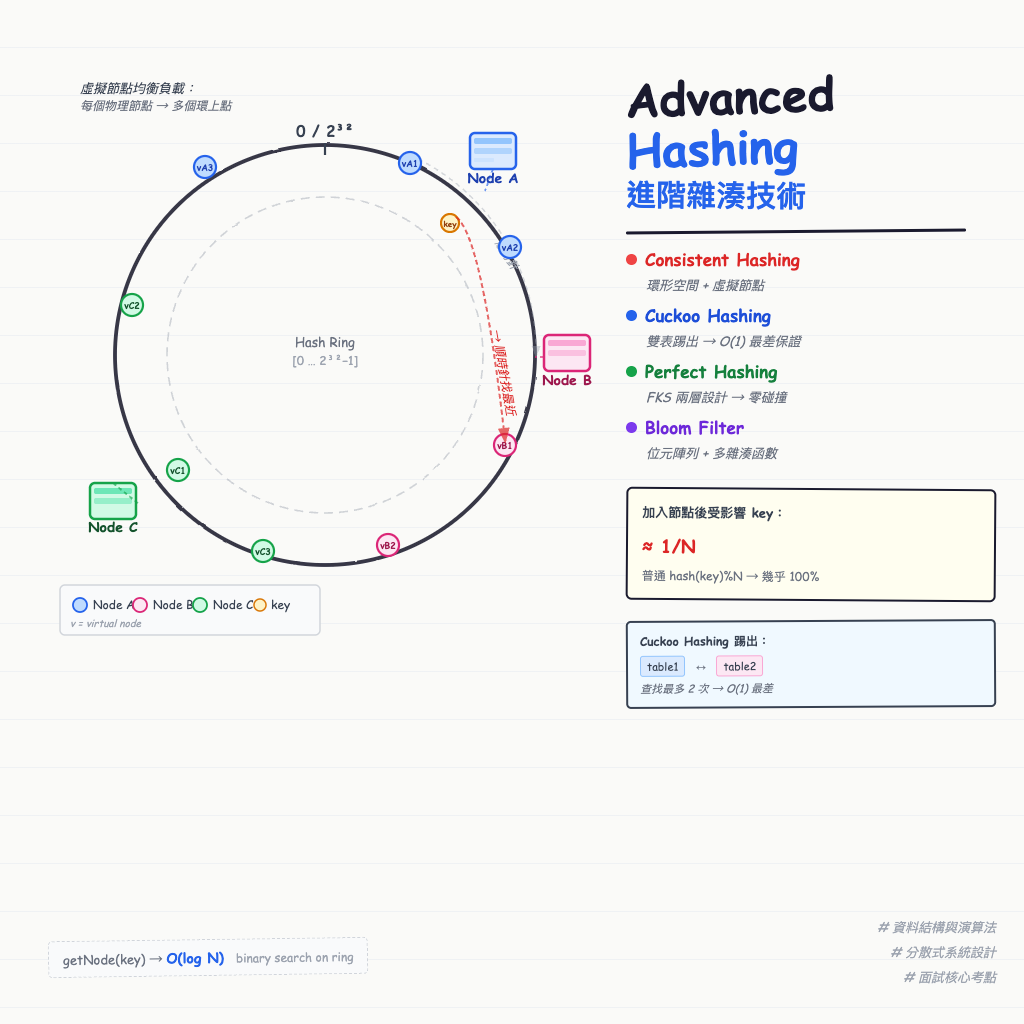
進階雜湊技術(Advanced Hashing)是基礎雜湊表向特殊場景的延伸:Consistent Hashing 解決分散式節點增減時幾乎所有 key 都需要重新映射的問題;Cuckoo Hashing 透過雙表踢出機制,讓查詢在最壞情況下也只需兩次存取;Perfect Hashing 則用兩層設計徹底消除碰撞。這些技術是 Memcached、Redis Cluster 與系統設計面試的核心考點。
前言
想像你在管理一個分散式快取集群,有三台伺服器。用最簡單的方式分片:server = hash(key) % 3。運作正常——直到你需要擴容,加入第四台伺服器。
一旦 N 從 3 變成 4,hash(key) % 3 的結果與 hash(key) % 4 幾乎完全不同。你的 99% 快取瞬間失效,所有請求直接打到資料庫,造成 Cache Stampede(快取雪崩)。Facebook、Twitter 的早期事故,有不少就是這樣發生的。
Consistent Hashing(一致性雜湊) 正是為了解決這個問題而設計——增減節點時,平均只有 1/N 的 key 需要遷移。
讀完這篇文章,你將學會:
- 理解一致性雜湊環(Hash Ring)的運作原理與虛擬節點設計
- 掌握 Cuckoo Hashing 的雙表踢出機制與 O(1) 最壞保證
- 了解 Perfect Hashing(FKS)的兩層設計如何消除碰撞
- 實作 Bloom Filter 並分析假陽性率的數學背景
- 認識 Count-Min Sketch 與 HyperLogLog 在大數據中的應用
- 在系統設計面試中正確選用合適的雜湊技術
一致性雜湊(Consistent Hashing)
核心思想:環形空間
Consistent Hashing 的關鍵洞見是:把雜湊空間想像成一個環,而不是一條線。
- 建立一個虛擬環(Hash Ring),空間為
[0, 2³²-1],首尾相連 - 每台伺服器(節點)經雜湊後映射到環上的某個點
- 每個 key 也映射到環上,沿順時針方向找到的第一個節點就是負責節點
- 新增或移除節點時,只有相鄰區間的 key 受影響
Hash Ring(0 ─ 2³² - 1,首尾相連成環):

              0 / 2³²
                │
         Node A (hash = 3億)
        ╱───────┤
      ╱         │
 Node C ←       │     → Node B
(hash=9億)  ───┼───  (hash=6億)
             ╲  │  ╱
              ╲ │ ╱
               ╲│╱
                │

hash(key1)=4億 → 順時針 → 找到 Node B(6億)✓
hash(key2)=8億 → 順時針 → 找到 Node C(9億)✓
hash(key3)=10億 → 順時針 → 繞回 Node A(3億)✓

新增 Node D(hash=7.5億):
  → 只有原本 Node B → Node C 之間的 key 需要重新映射
  → 受影響比例:約 1/4(新增後共 4 個節點)
  → 普通取模(% N):幾乎 100% 的 key 都需要重新映射
虛擬節點解決負載不均
單一節點只有一個環上位置時,偶爾會出現某台伺服器負責 75% 的 key,而另一台只負責 5% 的情況。虛擬節點(Virtual Nodes) 解決了這個問題:
每個物理節點映射到環上的多個點(通常 100-200 個):

Node A:hash("NodeA#0"), hash("NodeA#1"), ..., hash("NodeA#149")
Node B:hash("NodeB#0"), hash("NodeB#1"), ..., hash("NodeB#149")

實際效果:各節點負責的 key 數量趨近 total_keys / N
虛擬節點越多,分布越均勻,但記憶體占用也越高
TypeScript 完整實作
// Consistent Hashing Ring — 完整實作(含虛擬節點)
// 使用 FNV-1a 雜湊函數,生產環境建議換成 MurmurHash3 或 xxHash

function hash32(str: string): number {
  let h = 2166136261; // FNV-1a 初始值
  for (let i = 0; i < str.length; i++) {
    h ^= str.charCodeAt(i);
    h = Math.imul(h, 16777619); // FNV prime
    h >>>= 0; // 轉為無符號 32-bit
  }
  return h;
}

interface RingEntry {
  hash: number;
  nodeId: string;    // 物理節點 ID
  virtualId: string; // 虛擬節點 ID("nodeId#i")
}

class ConsistentHashRing {
  private ring: RingEntry[]; // 按 hash 排序的虛擬節點列表
  private readonly virtualNodesPerServer: number;

  constructor(virtualNodesPerServer: number = 150) {
    this.ring = [];
    this.virtualNodesPerServer = virtualNodesPerServer;
  }

  // 新增節點:O(V log N),V=虛擬節點數,N=環上節點總數
  addNode(nodeId: string): void {
    for (let i = 0; i < this.virtualNodesPerServer; i++) {
      const virtualId = `${nodeId}#${i}`;
      const h = hash32(virtualId);
      const entry: RingEntry = { hash: h, nodeId, virtualId };
      const pos = this.lowerBound(h);
      this.ring.splice(pos, 0, entry); // 維持排序插入
    }
  }

  // 移除節點:O(V log N)
  removeNode(nodeId: string): void {
    this.ring = this.ring.filter((entry) => entry.nodeId !== nodeId);
    // 注意:必須移除所有虛擬節點,只移除部分會造成路由錯誤
  }

  // 查找 key 對應的節點:O(log N)
  getNode(key: string): string | null {
    if (this.ring.length === 0) return null;
    const h = hash32(key);
    const pos = this.lowerBound(h);
    const idx = pos < this.ring.length ? pos : 0; // 繞回環的開頭
    return this.ring[idx].nodeId;
  }

  // 查找 key 對應的 N 個節點(Replication Factor)
  getNodes(key: string, count: number): string[] {
    if (this.ring.length === 0) return [];
    const h = hash32(key);
    let pos = this.lowerBound(h);
    const result: string[] = [];
    const seen = new Set<string>();

    for (let i = 0; i < this.ring.length && result.length < count; i++) {
      const idx = (pos + i) % this.ring.length;
      const nodeId = this.ring[idx].nodeId;
      if (!seen.has(nodeId)) {
        seen.add(nodeId);
        result.push(nodeId);
      }
    }
    return result;
  }

  // 二元搜尋:找到第一個 hash >= target 的位置
  private lowerBound(target: number): number {
    let lo = 0;
    let hi = this.ring.length;
    while (lo < hi) {
      const mid = (lo + hi) >>> 1;
      if (this.ring[mid].hash < target) {
        lo = mid + 1;
      } else {
        hi = mid;
      }
    }
    return lo;
  }

  // 負載分析
  getLoadDistribution(): Map<string, number> {
    const dist = new Map<string, number>();
    for (const entry of this.ring) {
      dist.set(entry.nodeId, (dist.get(entry.nodeId) ?? 0) + 1);
    }
    return dist;
  }
}

// 模擬分散式快取集群
const ring = new ConsistentHashRing(150);
ring.addNode("cache-1");
ring.addNode("cache-2");
ring.addNode("cache-3");

console.log(ring.getNode("user:1001"));      // 輸出:"cache-2"(穩定路由)
console.log(ring.getNodes("product:500", 2)); // 輸出:["cache-3", "cache-1"](副本)

ring.addNode("cache-4"); // 擴容:只影響約 1/4 的 key
console.log(ring.getNode("user:1001")); // 可能不變,也可能路由到 cache-4
Cuckoo Hashing — O(1) 最壞查詢
踢出機制圖解
Cuckoo Hashing 名稱來自布穀鳥(Cuckoo)把蛋放入別人巢中的行為。核心設計:使用兩張表和兩個雜湊函數,每個 key 只可能在 table1[h1(key)] 或 table2[h2(key)] 這兩個位置之一。
初始狀態:
  table1: [ A ][ B ][ _ ]
  table2: [ _ ][ C ][ _ ]

插入 D,h1(D)=0,但 table1[0] 已被 A 佔用:
  → 踢出 A,將 D 放入 table1[0]
  table1: [ D ][ B ][ _ ]

被踢出的 A 嘗試 table2[h2(A)]=1,已被 C 佔用:
  → 踢出 C,將 A 放入 table2[1]
  table2: [ _ ][ A ][ _ ]

被踢出的 C 嘗試 table1[h1(C)]=2(空位):
  → C 直接放入
  table1: [ D ][ B ][ C ]

最終狀態:
  table1: [ D ][ B ][ C ]
  table2: [ _ ][ A ][ _ ]

查找 key:只需查 table1[h1(key)] 或 table2[h2(key)],最多 2 次 → O(1) 最壞
TypeScript 實作
// Cuckoo Hashing — 保證 O(1) 最壞查找
const CUCKOO_MAX_EVICTIONS = 500; // 超過則觸發 Rehash

class CuckooHashTable<V> {
  private table1: Array<{ key: string; value: V } | null>;
  private table2: Array<{ key: string; value: V } | null>;
  private capacity: number;
  private size_: number;

  constructor(initialCapacity: number = 64) {
    this.capacity = initialCapacity;
    this.size_ = 0;
    this.table1 = new Array(this.capacity).fill(null);
    this.table2 = new Array(this.capacity).fill(null);
  }

  // 雜湊函數1(FNV-1a)
  private h1(key: string): number {
    let h = 2166136261;
    for (let i = 0; i < key.length; i++) {
      h ^= key.charCodeAt(i);
      h = Math.imul(h, 16777619);
    }
    return (h >>> 0) % this.capacity;
  }

  // 雜湊函數2(djb2 變體,必須與 h1 獨立)
  private h2(key: string): number {
    let h = 5381;
    for (let i = 0; i < key.length; i++) {
      h = Math.imul(h, 33) ^ key.charCodeAt(i);
    }
    return (h >>> 0) % this.capacity;
  }

  // 查找:O(1) 最壞(只需看兩個位置)
  get(key: string): V | undefined {
    const pos1 = this.h1(key);
    if (this.table1[pos1]?.key === key) return this.table1[pos1]!.value;
    const pos2 = this.h2(key);
    if (this.table2[pos2]?.key === key) return this.table2[pos2]!.value;
    return undefined;
  }

  has(key: string): boolean {
    return this.get(key) !== undefined;
  }

  // 插入:O(1) amortized
  set(key: string, value: V): boolean {
    // 先檢查是否已存在(更新)
    const pos1 = this.h1(key);
    if (this.table1[pos1]?.key === key) {
      this.table1[pos1] = { key, value };
      return true;
    }
    const pos2 = this.h2(key);
    if (this.table2[pos2]?.key === key) {
      this.table2[pos2] = { key, value };
      return true;
    }
    return this.insertWithEviction(key, value);
  }

  private insertWithEviction(key: string, value: V): boolean {
    let currentKey = key;
    let currentValue = value;
    let useTable1 = true;

    for (let evictions = 0; evictions < CUCKOO_MAX_EVICTIONS; evictions++) {
      if (useTable1) {
        const pos = this.h1(currentKey);
        const displaced = this.table1[pos];
        this.table1[pos] = { key: currentKey, value: currentValue };
        if (displaced === null) {
          this.size_++;
          return true;
        }
        currentKey = displaced.key;
        currentValue = displaced.value;
      } else {
        const pos = this.h2(currentKey);
        const displaced = this.table2[pos];
        this.table2[pos] = { key: currentKey, value: currentValue };
        if (displaced === null) {
          this.size_++;
          return true;
        }
        currentKey = displaced.key;
        currentValue = displaced.value;
      }
      useTable1 = !useTable1; // 交替使用兩張表
    }

    // 超過最大踢出次數,表示可能形成循環,觸發 Rehash
    this.rehash();
    return this.set(currentKey, currentValue);
  }

  // 刪除:O(1)
  delete(key: string): boolean {
    const pos1 = this.h1(key);
    if (this.table1[pos1]?.key === key) {
      this.table1[pos1] = null;
      this.size_--;
      return true;
    }
    const pos2 = this.h2(key);
    if (this.table2[pos2]?.key === key) {
      this.table2[pos2] = null;
      this.size_--;
      return true;
    }
    return false;
  }

  private rehash(): void {
    const oldTable1 = this.table1;
    const oldTable2 = this.table2;
    this.capacity *= 2;
    this.table1 = new Array(this.capacity).fill(null);
    this.table2 = new Array(this.capacity).fill(null);
    this.size_ = 0;
    for (const entry of [...oldTable1, ...oldTable2]) {
      if (entry !== null) this.set(entry.key, entry.value);
    }
  }

  get size(): number { return this.size_; }
  get loadFactor(): number { return this.size_ / (this.capacity * 2); }
}

// 使用範例
const cuckoo = new CuckooHashTable<number>();
cuckoo.set("apple", 1);
cuckoo.set("banana", 2);
cuckoo.set("cherry", 3);
console.log(cuckoo.get("banana"));  // 輸出:2
console.log(cuckoo.has("cherry"));  // 輸出:true
console.log(cuckoo.delete("apple")); // 輸出:true
console.log(cuckoo.get("apple"));   // 輸出:undefined
console.log(`負載因子:${cuckoo.loadFactor.toFixed(3)}`);
Perfect Hashing — 零碰撞靜態設計
Perfect Hashing 保證查詢在最壞情況下也是 O(1),且沒有碰撞。代價是它只適用於靜態集合(編譯時已知所有鍵值)。
FKS 兩層架構
Level 1(普通雜湊):
  → 將 n 個鍵值映射到 m 個桶,桶內可能有碰撞

Level 2(桶內二次雜湊):
  → 對每個桶使用獨立的雜湊函數
  → 桶的大小設為「桶內元素數量的平方」
  → 數學保證:此大小下必然存在無碰撞的雜湊函數

性質:
  → 查找:O(1) 最壞(兩次雜湊計算)
  → 空間:O(n)(雖然每個桶是平方大小,但總空間仍為線性)
  → 建構:O(n) 期望(需要嘗試不同的雜湊函數)
  → 限制:插入或刪除都需要完全重建
// Perfect Hashing(FKS Scheme)— 靜態集合查找
class PerfectHashTable {
  private level1Size: number;
  private level1Hash: (key: string) => number;
  // 第二層:每個桶有自己的雜湊函數和儲存空間
  private level2: Array<{
    fn: (key: string) => number;
    storage: Array<string | null>;
  }>;

  constructor(keys: string[]) {
    const n = keys.length;
    this.level1Size = n; // 第一層大小 = n

    // 找一個第一層雜湊函數使碰撞數最小
    this.level1Hash = this.buildLevel1Hash(keys);

    // 依第一層分配到各桶
    const buckets: string[][] = Array.from({ length: n }, () => []);
    for (const key of keys) {
      buckets[this.level1Hash(key)].push(key);
    }

    // 對每個桶建立第二層(無碰撞)
    this.level2 = buckets.map((bucket) => {
      const size = bucket.length * bucket.length; // 平方大小
      const storage = new Array(Math.max(size, 1)).fill(null);
      const fn = this.buildLevel2Hash(bucket, storage);
      return { fn, storage };
    });
  }

  get(key: string): boolean {
    const b = this.level1Hash(key);
    if (b >= this.level2.length) return false;
    const { fn, storage } = this.level2[b];
    const pos = fn(key);
    return storage[pos] === key;
  }

  private buildLevel1Hash(keys: string[]): (key: string) => number {
    // 實際實作中會嘗試多個隨機種子找最少碰撞的
    const n = keys.length;
    return (key: string) => {
      let h = 2166136261;
      for (let i = 0; i < key.length; i++) {
        h ^= key.charCodeAt(i);
        h = Math.imul(h, 16777619);
      }
      return (h >>> 0) % n;
    };
  }

  private buildLevel2Hash(
    bucket: string[],
    storage: Array<string | null>
  ): (key: string) => number {
    const size = storage.length;
    // 嘗試不同種子,直到找到無碰撞的雜湊函數
    for (let seed = 1; seed < 1000; seed++) {
      const fn = (key: string) => {
        let h = seed;
        for (let i = 0; i < key.length; i++) {
          h ^= key.charCodeAt(i);
          h = Math.imul(h, 16777619 + seed);
        }
        return (h >>> 0) % size;
      };
      const slots = new Set<number>();
      let collision = false;
      for (const key of bucket) {
        const pos = fn(key);
        if (slots.has(pos)) { collision = true; break; }
        slots.add(pos);
      }
      if (!collision) {
        // 無碰撞:填入 storage 並回傳此函數
        for (const key of bucket) {
          storage[fn(key)] = key;
        }
        return fn;
      }
    }
    // 極罕見情況:fallback(不應發生在正確實作中)
    return () => 0;
  }
}

// 使用範例:編譯器關鍵字查找
const keywords = ["if", "else", "for", "while", "return", "const", "let", "var", "class", "function"];
const keywordSet = new PerfectHashTable(keywords);

console.log(keywordSet.get("if"));      // 輸出:true
console.log(keywordSet.get("return"));  // 輸出:true
console.log(keywordSet.get("myVar"));   // 輸出:false
Bloom Filter — 空間高效的集合存在性查詢
Bloom Filter 是一種機率性資料結構,用 m 位元的陣列加上 k 個雜湊函數,空間效率極高,但可能出現假陽性(False Positive),不存在的元素可能被誤判為存在;存在的元素則一定能被正確識別(不會有假陰性)。
插入 "apple"(k=3 個雜湊函數):
  h1("apple")=2 → 位元 2 設為 1
  h2("apple")=5 → 位元 5 設為 1
  h3("apple")=9 → 位元 9 設為 1

查詢 "apple":
  位元 2=1 ✓, 位元 5=1 ✓, 位元 9=1 ✓ → 存在(正確)

查詢 "grape":
  h1("grape")=2=1, h2("grape")=5=1, h3("grape")=7=0 → 不存在(正確)

查詢 "mango":
  h1("mango")=2=1, h2("mango")=5=1, h3("mango")=9=1 → 「存在」(假陽性!)
  → "mango" 從未被插入,但三個位元碰巧都被其他元素設為 1
假陽性率數學分析
假陽性率 p ≈ (1 - e^(-kn/m))^k

其中:
  m = 位元陣列大小
  n = 已插入的元素數量
  k = 雜湊函數數量

最佳 k 值(使假陽性率最小):k = (m/n) * ln(2) ≈ 0.693 * (m/n)

實際案例(n=10,000,期望假陽性率 1%):
  → m ≈ 95,851 位元(約 12KB,遠小於存完整字串的空間)
  → k ≈ 7 個雜湊函數
// Bloom Filter 完整實作
class BloomFilter {
  private bits: Uint8Array;
  private readonly m: number; // 位元數
  private readonly k: number; // 雜湊函數數量
  private count: number;      // 已插入元素數

  constructor(expectedElements: number, falsePositiveRate: number = 0.01) {
    // 根據期望元素數和假陽性率計算最佳參數
    this.m = Math.ceil(
      (-expectedElements * Math.log(falsePositiveRate)) / (Math.LN2 ** 2)
    );
    this.k = Math.max(1, Math.round((this.m / expectedElements) * Math.LN2));
    this.bits = new Uint8Array(Math.ceil(this.m / 8));
    this.count = 0;
    console.log(`Bloom Filter: m=${this.m} bits, k=${this.k} hash functions`);
  }

  // 使用種子產生不同的雜湊函數(Kirsch-Mitzenmacher 方法)
  private hash(item: string, seed: number): number {
    // 基礎雜湊 h1 和 h2
    let h1 = 2166136261;
    let h2 = 5381;
    for (let i = 0; i < item.length; i++) {
      h1 ^= item.charCodeAt(i);
      h1 = Math.imul(h1, 16777619);
      h2 = Math.imul(h2, 33) ^ item.charCodeAt(i);
    }
    // 第 i 個雜湊 = h1 + i * h2(只需兩個基礎雜湊即可模擬 k 個)
    return ((h1 >>> 0) + seed * (h2 >>> 0)) % this.m;
  }

  private setBit(pos: number): void {
    this.bits[Math.floor(pos / 8)] |= (1 << (pos % 8));
  }

  private getBit(pos: number): boolean {
    return (this.bits[Math.floor(pos / 8)] & (1 << (pos % 8))) !== 0;
  }

  add(item: string): void {
    for (let i = 0; i < this.k; i++) {
      this.setBit(this.hash(item, i));
    }
    this.count++;
  }

  // 查詢:可能有假陽性,但不會有假陰性
  mightContain(item: string): boolean {
    for (let i = 0; i < this.k; i++) {
      if (!this.getBit(this.hash(item, i))) return false;
    }
    return true; // 可能存在(有小概率假陽性)
  }

  get estimatedFalsePositiveRate(): number {
    const ratio = 1 - Math.exp(-this.k * this.count / this.m);
    return ratio ** this.k;
  }

  get bitsUsed(): number { return this.m; }
  get numHashFunctions(): number { return this.k; }
}

// 使用範例:URL 去重(爬蟲)
const filter = new BloomFilter(100_000, 0.01); // 10 萬 URL,1% 假陽性率
// 輸出:Bloom Filter: m=958506 bits, k=7 hash functions(約 117KB)

filter.add("https://example.com/page1");
filter.add("https://example.com/page2");

console.log(filter.mightContain("https://example.com/page1")); // 輸出:true(確定存在)
console.log(filter.mightContain("https://example.com/page99")); // 輸出:false(不存在)
console.log(`預期假陽性率:${(filter.estimatedFalsePositiveRate * 100).toFixed(4)}%`);
C++ 對照:ConsistentHashRing
#include <map>
#include <string>
#include <vector>
#include <algorithm>

// 使用 std::map(底層紅黑樹,自動有序)實作一致性雜湊
// 相較 TypeScript 的 sorted array,C++ 的 std::map::lower_bound 更高效

uint32_t hashString(const std::string& s) {
    uint32_t h = 2166136261u;
    for (unsigned char c : s) {
        h ^= c;
        h *= 16777619u;
    }
    return h;
}

class ConsistentHashRing {
private:
    std::map<uint32_t, std::string> ring; // 自動按 hash 排序
    int virtualNodesPerServer;

public:
    explicit ConsistentHashRing(int virtualNodes = 150)
        : virtualNodesPerServer(virtualNodes) {}

    // 新增節點:O(V log N)
    void addNode(const std::string& nodeId) {
        for (int i = 0; i < virtualNodesPerServer; i++) {
            const std::string virtualId = nodeId + "#" + std::to_string(i);
            ring[hashString(virtualId)] = nodeId;
        }
    }

    // 移除節點:O(V log N)
    void removeNode(const std::string& nodeId) {
        for (int i = 0; i < virtualNodesPerServer; i++) {
            const std::string virtualId = nodeId + "#" + std::to_string(i);
            ring.erase(hashString(virtualId));
        }
    }

    // 查找 key 對應節點:O(log N)
    std::string getNode(const std::string& key) const {
        if (ring.empty()) return "";
        auto it = ring.lower_bound(hashString(key)); // 找 >= hash 的第一個節點
        if (it == ring.end()) it = ring.begin();     // 繞回環的開頭
        return it->second;
    }

    // 查找 N 個節點(副本)
    std::vector<std::string> getNodes(const std::string& key, int count) const {
        if (ring.empty()) return {};
        auto it = ring.lower_bound(hashString(key));
        std::vector<std::string> result;
        std::vector<std::string> seen;

        auto startIt = it;
        bool wrapped = false;
        while (static_cast<int>(result.size()) < count) {
            if (it == ring.end()) {
                if (wrapped) break;
                it = ring.begin();
                wrapped = true;
            }
            if (wrapped && it == startIt) break;
            const std::string& nodeId = it->second;
            if (std::find(seen.begin(), seen.end(), nodeId) == seen.end()) {
                seen.push_back(nodeId);
                result.push_back(nodeId);
            }
            ++it;
        }
        return result;
    }
};

// 使用範例
// ConsistentHashRing ring(150);
// ring.addNode("cache-server-1");
// ring.addNode("cache-server-2");
// ring.addNode("cache-server-3");
// std::string server = ring.getNode("user:1001"); // 確定性路由
複雜度分析表
| 技術 | 查找(最壞) | 查找(平均) | 插入 | 刪除 | 適用場景 |
|---|---|---|---|---|---|
| Consistent Hashing | O(log N) | O(log N) | O(V log N) | O(V log N) | 分散式快取節點分配 |
| Cuckoo Hashing | O(1) | O(1) | O(1) amortized | O(1) | 需要 O(1) 最壞保證 |
| Perfect Hashing | O(1) | O(1) | O(n) 重建 | O(n) 重建 | 靜態集合查找 |
| Bloom Filter | N/A | O(k) | O(k) | 不支援 | 集合存在性(允許假陽性) |
| Robin Hood Hash | O(log n) | O(1) | O(1) amortized | O(1) | 高負載因子場景 |
N = 環上虛擬節點總數,V = 每個節點的虛擬節點數,k = 雜湊函數數量
變體與延伸
Counting Bloom Filter — 支援刪除
標準 Bloom Filter 無法刪除元素(設為 1 的位元無法確定是哪個元素設置的)。Counting Bloom Filter 將每個位元升級為計數器(通常 4-bit):
// Counting Bloom Filter — 支援刪除操作
class CountingBloomFilter {
  private counters: Uint8Array; // 4-bit 計數器,每個 byte 存兩個

  constructor(private readonly m: number, private readonly k: number) {
    this.counters = new Uint8Array(Math.ceil(m / 2)); // 每 4-bit 一個計數器
  }

  private increment(pos: number): void {
    const byteIdx = Math.floor(pos / 2);
    const isHigh = pos % 2 === 1;
    const current = isHigh
      ? (this.counters[byteIdx] >> 4) & 0xF
      : this.counters[byteIdx] & 0xF;
    if (current < 15) { // 防止 4-bit 溢位
      if (isHigh) this.counters[byteIdx] += 0x10;
      else this.counters[byteIdx]++;
    }
  }

  private decrement(pos: number): void {
    const byteIdx = Math.floor(pos / 2);
    const isHigh = pos % 2 === 1;
    const current = isHigh
      ? (this.counters[byteIdx] >> 4) & 0xF
      : this.counters[byteIdx] & 0xF;
    if (current > 0) {
      if (isHigh) this.counters[byteIdx] -= 0x10;
      else this.counters[byteIdx]--;
    }
  }

  private getCount(pos: number): number {
    const byteIdx = Math.floor(pos / 2);
    const isHigh = pos % 2 === 1;
    return isHigh
      ? (this.counters[byteIdx] >> 4) & 0xF
      : this.counters[byteIdx] & 0xF;
  }

  private hash(item: string, seed: number): number {
    let h1 = 2166136261, h2 = 5381;
    for (let i = 0; i < item.length; i++) {
      h1 ^= item.charCodeAt(i); h1 = Math.imul(h1, 16777619);
      h2 = Math.imul(h2, 33) ^ item.charCodeAt(i);
    }
    return ((h1 >>> 0) + seed * (h2 >>> 0)) % this.m;
  }

  add(item: string): void {
    for (let i = 0; i < this.k; i++) this.increment(this.hash(item, i));
  }

  // 刪除:前提是元素確實存在(否則計數器可能出現錯誤)
  remove(item: string): void {
    for (let i = 0; i < this.k; i++) this.decrement(this.hash(item, i));
  }

  mightContain(item: string): boolean {
    for (let i = 0; i < this.k; i++) {
      if (this.getCount(this.hash(item, i)) === 0) return false;
    }
    return true;
  }
}
Count-Min Sketch — 高頻元素估計
當你需要的不是「是否存在」,而是「出現了幾次」,Count-Min Sketch 登場。用 d × w 的二維計數器陣列,每個元素透過 d 個雜湊函數映射到每列的一個位置,取各列計數的最小值作為估計:
// Count-Min Sketch — 頻率估計(允許過估,不會低估)
class CountMinSketch {
  private table: number[][];
  private readonly d: number; // 列數(雜湊函數數量)
  private readonly w: number; // 欄數(每列的計數器數量)

  constructor(epsilon: number = 0.01, delta: number = 0.01) {
    // d = ceil(ln(1/delta)),w = ceil(e/epsilon)
    this.d = Math.ceil(Math.log(1 / delta));
    this.w = Math.ceil(Math.E / epsilon);
    this.table = Array.from({ length: this.d }, () => new Array(this.w).fill(0));
  }

  private hash(item: string, row: number): number {
    let h = (row + 1) * 2654435761;
    for (let i = 0; i < item.length; i++) {
      h = Math.imul(h ^ item.charCodeAt(i), 2246822519);
    }
    return (h >>> 0) % this.w;
  }

  // 增加計數
  update(item: string, count: number = 1): void {
    for (let i = 0; i < this.d; i++) {
      this.table[i][this.hash(item, i)] += count;
    }
  }

  // 估計頻率:取各列最小值(保證不低估)
  estimate(item: string): number {
    let min = Infinity;
    for (let i = 0; i < this.d; i++) {
      min = Math.min(min, this.table[i][this.hash(item, i)]);
    }
    return min;
  }
}

// 使用範例:統計網路流量中各 IP 的封包數
const sketch = new CountMinSketch(0.01, 0.01); // 誤差 1%,失敗機率 1%
sketch.update("192.168.1.1", 100);
sketch.update("10.0.0.1", 50);
sketch.update("192.168.1.1", 200);

console.log(sketch.estimate("192.168.1.1")); // 輸出:約 300(可能略有過估)
console.log(sketch.estimate("10.0.0.1"));    // 輸出:約 50
HyperLogLog — 基數估計
需要知道有多少不重複元素(基數)?HyperLogLog 只用 1.5KB 的記憶體就能估計數十億個不重複元素,誤差僅約 2%。Redis 的 PFADD/PFCOUNT 指令就是 HyperLogLog 的實作。
// HyperLogLog — 基數(不重複元素數量)估計
class HyperLogLog {
  private readonly m: number;      // 桶數(2^b)
  private readonly b: number;      // 位元數
  private registers: Uint8Array;   // 每個桶儲存最大前導零數+1

  constructor(b: number = 10) {   // b=10 → m=1024 桶,誤差約 3.2%
    this.b = b;
    this.m = 1 << b;               // 輸出:1024
    this.registers = new Uint8Array(this.m);
  }

  private hash(item: string): number {
    let h = 2166136261;
    for (let i = 0; i < item.length; i++) {
      h ^= item.charCodeAt(i);
      h = Math.imul(h, 16777619);
    }
    return h >>> 0;
  }

  // 計算前導零數量(+1)
  private leadingZeros(hash: number, skip: number): number {
    let mask = 1 << (31 - skip);
    let count = 1;
    while (mask > 0 && (hash & mask) === 0) {
      count++;
      mask >>= 1;
    }
    return count;
  }

  add(item: string): void {
    const hash = this.hash(item);
    const bucket = hash >>> (32 - this.b); // 用前 b 位決定桶
    const remaining = hash & ((1 << (32 - this.b)) - 1); // 剩餘位
    const zeros = this.leadingZeros(remaining, 0);
    this.registers[bucket] = Math.max(this.registers[bucket], zeros);
  }

  // 估計基數
  count(): number {
    const alpha = 0.7213 / (1 + 1.079 / this.m); // 修正係數
    let sum = 0;
    for (let i = 0; i < this.m; i++) {
      sum += 2 ** -this.registers[i];
    }
    let estimate = alpha * this.m * this.m / sum;

    // 小基數修正
    if (estimate <= 2.5 * this.m) {
      const zeros = this.registers.filter((r) => r === 0).length;
      if (zeros > 0) estimate = this.m * Math.log(this.m / zeros);
    }
    return Math.round(estimate);
  }
}

// 使用範例:統計獨立訪客數(UV)
const hll = new HyperLogLog(10); // 約 1KB 記憶體
const users = ["alice", "bob", "charlie", "alice", "bob", "diana"]; // 實際 4 人
for (const user of users) hll.add(user);
console.log(`估計不重複用戶數:${hll.count()}`); // 輸出:約 4(允許小誤差)
面試考點
系統設計:分散式快取設計
問題: 設計一個可水平擴展的分散式快取系統(類 Memcached)。
回答要點:
分片策略選擇
- 普通取模(
hash(key) % N):實作最簡單,但擴容時幾乎所有 key 需要遷移,造成快取雪崩 - Consistent Hashing(推薦):擴容只影響
1/N的 key,搭配虛擬節點確保負載均衡
- 普通取模(
虛擬節點數量
- 太少(< 50):節點分布不均,某台伺服器可能承擔 30%+ 的流量
- 太多(> 300):記憶體占用增加,新增節點時的計算成本上升
- 推薦 100-200 個:在均衡性和效率間取得平衡
副本策略(Replication)
getNodes(key, replicationFactor)取順時針最近的 N 個不同物理節點- 讀寫可分為一致性優先(所有副本一致)或可用性優先(最終一致性)
節點故障處理
- 心跳檢測:定期偵測節點狀態
- 故障轉移:
removeNode()後,原節點負責的 key 自動路由到下一個節點
// 面試實作:帶副本的分散式快取
class DistributedCache {
  private ring: ConsistentHashRing;
  private stores: Map<string, Map<string, string>>;
  private readonly replicationFactor: number;

  constructor(servers: string[], replicationFactor: number = 2) {
    this.ring = new ConsistentHashRing(150);
    this.stores = new Map();
    this.replicationFactor = replicationFactor;

    for (const server of servers) {
      this.ring.addNode(server);
      this.stores.set(server, new Map());
    }
  }

  set(key: string, value: string): void {
    const servers = this.ring.getNodes(key, this.replicationFactor);
    for (const server of servers) {
      this.stores.get(server)?.set(key, value);
    }
  }

  get(key: string): string | null {
    const servers = this.ring.getNodes(key, this.replicationFactor);
    for (const server of servers) {
      const val = this.stores.get(server)?.get(key);
      if (val !== undefined) return val;
    }
    return null;
  }

  addServer(server: string): void {
    this.ring.addNode(server);
    this.stores.set(server, new Map());
    // 實際系統需要將受影響的 key 從舊節點遷移到新節點
  }

  removeServer(server: string): void {
    this.ring.removeNode(server);
    this.stores.delete(server);
    // 實際系統需要從副本重新補充受影響 key 的副本
  }
}
去重系統設計
問題: 設計一個能高效判斷 URL 是否已被爬取的系統(數十億 URL 規模)。
| 方案 | 記憶體 | 假陽性 | 刪除支援 | 適用場景 |
|---|---|---|---|---|
| HashSet | 極大(100+ GB) | 無 | 支援 | 小規模(< 1 億) |
| Bloom Filter | 極小(~1GB/10億) | 有(可控) | 不支援 | 大規模,允許極少誤判 |
| Counting Bloom Filter | 較小(~4GB/10億) | 有(可控) | 支援 | 需要刪除操作 |
| Redis + HyperLogLog | 小(~1.5KB/集合) | 有 | 不精確 | 只需計數,不需精確判斷 |
推薦架構:
- 第一層:Bloom Filter(快速預判,99%+ 命中)
- 第二層:持久化 DB 或 Redis(最終確認)
LeetCode 練習
| # | 題目 | 難度 | 核心技巧 |
|---|---|---|---|
| 705 | Design HashSet | Easy | 雜湊表基礎 |
| 706 | Design HashMap | Easy | 雜湊表基礎 |
| 187 | Repeated DNA Sequences | Medium | Rolling Hash 滑動視窗去重 |
| 1044 | Longest Duplicate Substring | Hard | Binary Search + Rolling Hash |
| 355 | Design Twitter | Medium | 雜湊表 + 系統設計 |
1044 — Longest Duplicate Substring 解題思路
問題: 找出字串 s 中最長的重複子字串(允許重疊)。
思路:Binary Search + Rolling Hash(Rabin-Karp)
- 二元搜尋長度
L:若長度L的重複子字串存在,則長度L-1也一定存在(單調性) - Rolling Hash 驗證長度
L:計算所有長度L的子字串雜湊,若有重複則找到答案
// 1044. Longest Duplicate Substring
function longestDupSubstring(s: string): string {
  const n = s.length;
  const MOD1 = 1_000_000_007n;
  const MOD2 = 998_244_353n;
  const BASE1 = 31n;
  const BASE2 = 37n;
  const codes = Array.from(s, (c) => BigInt(c.charCodeAt(0) - 96));

  // 檢查是否有長度 len 的重複子字串
  function check(len: number): number {
    let pow1 = 1n, pow2 = 1n;
    for (let i = 0; i < len; i++) {
      pow1 = (pow1 * BASE1) % MOD1;
      pow2 = (pow2 * BASE2) % MOD2;
    }

    let h1 = 0n, h2 = 0n;
    for (let i = 0; i < len; i++) {
      h1 = (h1 * BASE1 + codes[i]) % MOD1;
      h2 = (h2 * BASE2 + codes[i]) % MOD2;
    }

    const seen = new Map<string, number>();
    seen.set(`${h1},${h2}`, 0);

    for (let i = 1; i <= n - len; i++) {
      // Rolling Hash:移除最左字符,加入新字符(O(1) 更新)
      h1 = (h1 * BASE1 - codes[i - 1] * pow1 % MOD1 + MOD1 + codes[i + len - 1]) % MOD1;
      h2 = (h2 * BASE2 - codes[i - 1] * pow2 % MOD2 + MOD2 + codes[i + len - 1]) % MOD2;

      const key = `${h1},${h2}`;
      if (seen.has(key)) {
        const prevStart = seen.get(key)!;
        // 雙重雜湊後假陽性率極低,但仍做最終字串比較
        if (s.substring(prevStart, prevStart + len) === s.substring(i, i + len)) {
          return i;
        }
      }
      seen.set(key, i);
    }
    return -1;
  }

  // 二元搜尋最長長度
  let lo = 0, hi = n - 1;
  let resultStart = -1, resultLen = 0;

  while (lo <= hi) {
    const mid = (lo + hi) >>> 1;
    const idx = check(mid);
    if (idx !== -1) {
      resultStart = idx;
      resultLen = mid;
      lo = mid + 1; // 嘗試更長
    } else {
      hi = mid - 1; // 長度不夠,縮短
    }
  }

  return resultStart === -1 ? "" : s.substring(resultStart, resultStart + resultLen);
}

// 測試
console.log(longestDupSubstring("banana")); // 輸出:"ana"(長度 3)
console.log(longestDupSubstring("abcd"));   // 輸出:""(無重複)
複雜度:
- 時間:O(n log n)——二元搜尋 O(log n) 次,每次 Rolling Hash 驗證 O(n)
- 空間:O(n)——雜湊表儲存各子字串雜湊值
常見陷阱
1. Consistent Hashing 移除節點時忘記清除所有虛擬節點
// 錯誤:只移除一個虛擬節點,其他 149 個還在環上
function badRemove(ring: Map<number, string>, nodeId: string): void {
  ring.delete(hash32(nodeId)); // 只刪一個!
}

// 正確:移除所有對應虛擬節點
function goodRemove(ring: ConsistentHashRing, nodeId: string): void {
  ring.removeNode(nodeId); // 內部循環移除所有 virtualNodesPerServer 個
}
2. Cuckoo Hashing 忽略踢出循環的可能性
// 問題:若 h1(A)=h1(B)=0, h2(A)=h2(B)=0,A 踢 B,B 踢 A,無限循環
// 解法:設定最大踢出次數 CUCKOO_MAX_EVICTIONS,超過則 Rehash
// 另一個常見解法:Cuckoo Hashing 的負載因子應保持在 0.5 以下
3. Bloom Filter 沒有假陰性≠沒有任何錯誤
// Bloom Filter 的錯誤模式:
// ✓ 存在的元素 → 一定返回 true(無假陰性)
// ✗ 不存在的元素 → 可能返回 true(假陽性率可控)
// ✗ 不存在的元素 → 不可能返回 false(這才是 false negative,確實不存在)

// 正確使用方式:
// if (!filter.mightContain(url)) {
//   // 確定不存在,可以安全跳過 DB 查詢
// } else {
//   // 可能存在,需要查 DB 確認(因為可能是假陽性)
//   const exists = await db.checkUrl(url);
// }
總結
進階雜湊技術的核心思想是:針對不同場景的限制,設計不同的取捨策略。
- Consistent Hashing:犧牲 O(1) 查找(改為 O(log N)),換取分散式節點增減時只影響 1/N 的 key,是 Memcached、Redis Cluster、Cassandra 等系統的核心基石
- Cuckoo Hashing:犧牲 O(1) 攤銷插入(需要踢出),換取 O(1) 最壞查找保證,適合快取查找場景
- Perfect Hashing:犧牲插入靈活性(靜態集合),換取零碰撞、O(1) 最壞查找,適合編譯器符號表
- Bloom Filter:犧牲精確性(允許假陽性),換取極低的記憶體占用,數十億元素只需幾 MB
這些技術在面試中常以「設計分散式快取」、「設計 URL 去重系統」、「設計推薦系統」等題目考察。
下一篇,我們將進入遞迴與回溯法(Recursion & Backtracking)——從遞迴樹的視覺化到剪枝優化,掌握 N-Queens、Sudoku Solver 等經典問題的系統化解題框架。
希望這篇文章能夠幫助你理解進階雜湊技術的核心原理與實際應用。如有任何問題或疑惑,歡迎到 Contact 頁面 留言交流!